

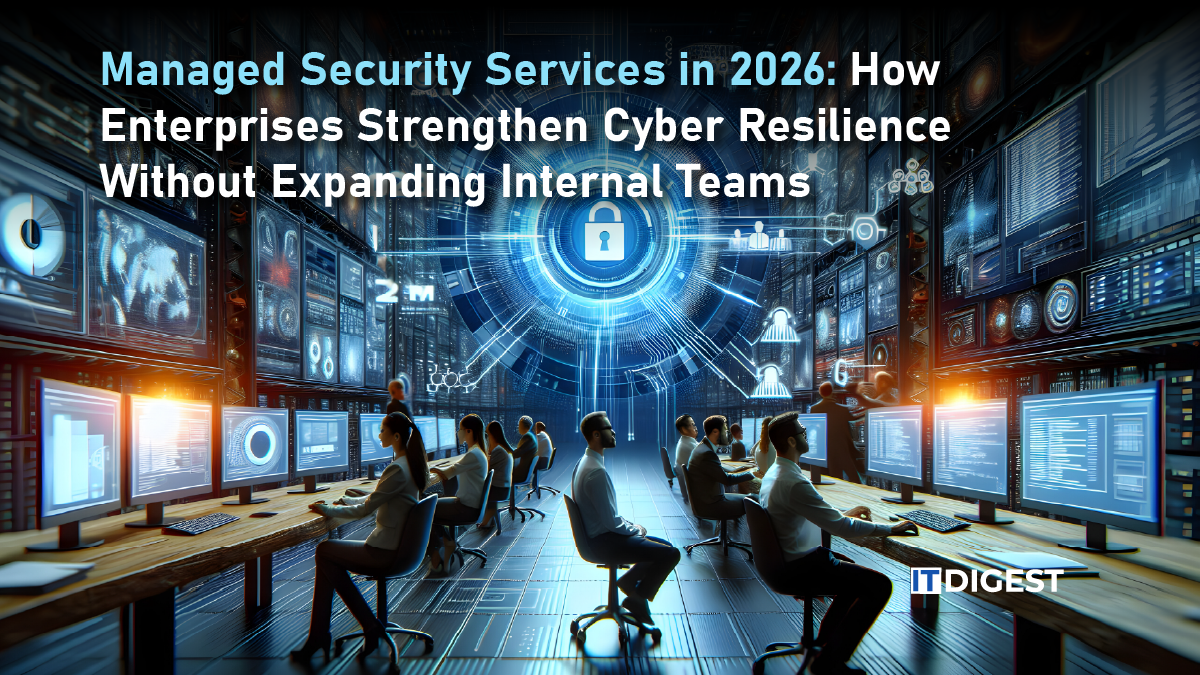
Cybersecurity is not what it used to be. Threats no longer move at human speed. They move at machine speed. Automated. AI-assisted. Fast. Relentless.
Meanwhile, the people who are supposed to stop them are running out. Not just in number, but in energy. Security teams are tired. Internal SOCs are burning out. Hiring more analysts is not working anymore. In fact, for many organizations, burnout and attrition are now as big a risk as the attacks themselves.
The numbers tell the story. In 2026, 94% of leaders say AI will be the biggest driver of change in cybersecurity. That is huge. It means the old ways do not work. The attacks are faster than any human can follow, and every missed alert becomes a business risk.
Enterprises tried the obvious fixes first. Hire more people. Build bigger SOCs. Stack more tools. Costs went up. Outcomes barely changed. Fatigue went up. Resilience did not. This is where managed security services come in. Not as outsourcing. Not as a shortcut. But as a way to build resilience together.
In 2026, these services are not about watching dashboards and forwarding alerts. They are the lever that lets enterprises scale detection, response, and resilience without adding a single internal headcount. Speed matters more than size now. The difference is not just in technology. It is in thinking differently about who does what and when.
The Evolution of MSS from Alerting to Outcome Engineering
Managed security services of 2023 were different. They did their job. Just not the job enterprises needed. Back then, most MSSPs acted like external watchers. Alerts came in. Tickets went out. The internal team still had to figure out what mattered and act.
That model is broken. Attackers stopped hitting perimeters. They moved to identities. Credentials. APIs. Automation. According to Mandiant investigations, 33% of initial intrusions were exploits, and stolen credentials accounted for 16%. Identity abuse became a top attack vector.
Imagine an enterprise waking up to an alert that an API key is being misused at three in the morning. In 2023, that alert might just sit in a ticket queue. By the time someone acts, damage is done. The 2026 MSSP solves this problem by acting instantly, automating containment and remediation while alerting internal teams only when human judgment is needed.
This is why forwarding alerts does not work anymore. Someone has to understand intent and context. And act fast. The MSSP of 2026 looks different. Detection is only the start. Response, containment, and recovery are built-in. Outcomes matter more than reports.
Here are the comparison enterprises should make.
Traditional MSSP
- Log monitoring and alert forwarding
- Reactive ticketing
- Limited business hours
- Tool-centered focus
Next-Gen 2026 Partner
- Proactive threat hunting
- Automated remediation
- 24 by 7 operations
- Protects identities, APIs, and business logic
This is not cosmetic. It is structural. The focus is on protecting how the business actually runs. That is why modern managed security services talk less about alerts and more about outcomes like faster response, contained incidents, and uninterrupted operations. The difference may feel subtle, but in practice it separates enterprises that survive from those that react too late.
Also Read: Data Security Compliance in 2026: How Enterprises Meet Regulations Without Slowing Innovation
Strengthening Resilience Without Headcount
Every security leader hits the same wall. There is a limit to how many people you can hire. Especially for repetitive, stressful, and relentless work. Modern managed security services break that ceiling.
Automation handles the noise. AI triages most Tier-1 alerts. That means phishing attempts, low-risk anomalies, and known attack patterns get handled without waking a human. Teams focus on decisions that actually need experience.
Next, MSSPs give access to niche expertise without hiring full-time. Cloud security architects. OT specialists. AI security experts. Expensive and rare if you hire them. Fractional and on-demand with MSS. One partner spreads cost without lowering quality.
Coverage is simple math. A 24 by 7 internal SOC needs at least 10 to 12 people, accounting for shifts and holidays. Most organizations cannot sustain that. MSSPs do it by default. Imagine a mid-sized firm trying to keep a SOC running overnight. One missed shift, and alerts pile up. With MSS, the coverage is instant and constant.
This is not theory. Security services, including managed security services and MDR, are among the fastest-growing segments in information security with double-digit growth. Growth comes from realizing resilience scales better through partnerships than payroll.
Smart teams do not replace internal security. They redesign it. Internal teams own business context and decisions. MSSPs absorb volume, speed, and complexity. Result: better control, not less.
Beyond headcount, the benefits show up in retention and morale. Analysts are no longer buried in tickets. Leaders spend less time firefighting. The organization can focus on strategy instead of chaos.
The Financial Case for MSS in 2026
Security budgets often stall conversations. Leaders care about risk. But security spend is unpredictable and hard to justify. Managed security services change that.
First, they shift from CAPEX to OPEX. No more buying hardware and tools upfront. Enterprises pay for outcomes as an operational expense. Costs are predictable. Forecasting is easier. Security stops feeling like a black hole.
Second, tool sprawl shrinks. Leading MSSPs bring their own stacks. XDR. SIEM. SOAR. Identity monitoring. Bundled. Renewals and overlapping licenses disappear. Focus shifts from owning tools to using capability.
Third, ROI is clearer. Compare MSS cost to downtime, penalties, or reputation damage after a breach. Even a few hours of disruption outweigh a year of managed protection. Hidden costs also vanish. Teams no longer waste hours chasing logs or reconciling tools. Audits and compliance become easier.
This clarity explains why adoption accelerates. Not because MSS is cheaper. Because it turns security from unpredictable spending into measurable business value. Enterprises now measure security like any other strategic function. Predictable. Reliable. Scalable.
What to Expect from a Next-Gen MSS Partner in 2026
Not all managed security services are equal. Depth matters more than logos. Identity Threat Detection and Response is the first capability. Identity is the primary attack surface. Identity-based attacks rose 32% in the first half of 2025, with 97% large-scale password attacks. Attackers are betting here.
MSSPs must monitor login patterns, privileges, token use, and service accounts. Not just endpoints. Not just malware. They track who is acting unusually.
Next is supply chain and third-party risk. Companies do not operate alone. Vendors, SaaS, and partners expand the attack surface. 65% of large firms say third-party vulnerabilities are the biggest barrier to resilience. MSSPs in 2026 monitor these continuously.
Finally, co-managed models are standard. Pure outsourcing rarely works. Pure insourcing rarely scales. Hybrid SOCs are better. MSSPs handle alert volume and automation. Internal teams provide business context and decisions.
Picture a finance company that struggles to process alerts overnight. With MSS, the alerts are triaged automatically. The internal team can focus on investigating high-impact threats and improving policies. That is where MSS delivers real value. It does not remove control. It amplifies it.
Compliance and Governance as a Service
Compliance is one of the strongest arguments for MSS. Rules are tighter. Timelines shorter. Evidence requirements heavier. Preparing for audits manually takes hundreds of hours. Teams do not have that time.
MSSPs automate it. Logging. Control validation. Reports. Part of daily operations. Compliance is no longer a last-minute scramble. It becomes part of routine security work.
This matters for companies dealing with multiple regulations. Automated reporting not only saves time, it reduces stress. Teams stop scrambling for proof. They know it is already done. That alone can justify a partnership.
Choosing the Right Partner
Choosing a partner is not about price. Look for transparency. Technology stack compatibility. Clear SLAs on mean time to respond, not just detect. Ask how they handle identity threats. Ask how they monitor supply chains. Ask what happens at three in the morning, not during a demo.
Resilience is not about how many people sit in your SOC. It is about how fast your organization adapts when something breaks. Managed security services are not a shortcut. They are the adaptation layer that lets enterprises survive what cybersecurity has become.
Choosing the wrong partner costs time, money, and sometimes the business itself. The right partner makes adaptation effortless. It is not magic. It is expertise, automation, and structure working together.
