

Here is ITDigest’s weekly roundup of the most important developments shaping global technology markets. This week’s highlights focus on AI governance, sovereign cloud security, quantum-safe infrastructure, digital healthcare, and next-generation enterprise automation as organizations continue to prepare for a more intelligent and security-focused future.
In Hardware and Network news this week…
Lightera and Nokia Partner to Expand Optical LAN Deployment Across Europe
Lightera and Nokia have partnered to accelerate the deployment of optical LAN infrastructure across Europe. The collaboration aims to provide enterprises with scalable, energy-efficient, and high-performance connectivity solutions. As organizations modernize network environments, optical LAN technology is emerging as a key enabler of next-generation digital infrastructure.
In Artificial Intelligence news this week…
Expert.ai and Fincons Expand Partnership to Advance Neuro-Symbolic AI Adoption
Expert.ai and Fincons Group are expanding their partnership to accelerate the adoption of neuro-symbolic AI solutions. By combining machine learning with symbolic reasoning, the collaboration aims to improve explainability, contextual understanding, and enterprise decision-making. This reflects the growing demand for more transparent and trustworthy AI systems.
In Cloud Security & Compliance news this week…
IBM Cloud Unveils Sovereignty Risk Profile to Strengthen AI and Data Compliance
IBM Cloud has introduced a Sovereignty Risk Profile solution designed to help enterprises address evolving AI and data compliance requirements. The offering provides organizations with deeper visibility into regulatory risks, data residency, and governance obligations. As global data regulations tighten, sovereign cloud strategies are becoming increasingly critical.
In Enterprise AI news this week…
Snowflake to Acquire Natoma to Strengthen Governance for Enterprise AI Agents
Snowflake has announced plans to acquire Natoma to strengthen governance and oversight for enterprise AI agents. The acquisition is aimed at helping organizations manage security, compliance, and operational control as AI agents become more autonomous. This highlights the growing importance of governance frameworks in enterprise AI adoption.
In Quantum Computing news this week…
Crypto4A Launches QXVault to Simplify Quantum-Safe Secrets Management
Crypto4A has launched QXVault, a platform designed to simplify quantum-safe secrets management. The solution helps organizations protect sensitive credentials and cryptographic assets against future quantum threats. As quantum computing advances, enterprises are increasingly investing in post-quantum security strategies to safeguard critical infrastructure.
In FinTech news this week…
OpenAI Unveils Self-Improving AI Tax Agents Powered by Codex
OpenAI has introduced self-improving AI tax agents powered by Codex to automate and optimize tax-related workflows. These AI agents are designed to continuously learn and adapt, improving efficiency and accuracy in financial operations. The development signals a growing shift toward autonomous AI systems in enterprise finance.
In HealthTech news this week…
JotPsych Launches JotMeet, an Integrated Telehealth Product
JotPsych has launched JotMeet, an integrated telehealth platform aimed at streamlining virtual care delivery. The solution combines communication, scheduling, and patient engagement tools to improve telemedicine experiences for healthcare providers and patients alike. This reflects the continued growth of digital healthcare services and remote care adoption.
In Cybersecurity news this week…
Proofpoint Expands AI Security Strategy with Claude Compliance API Integration
Proofpoint has expanded its AI security strategy through integration with the Claude Compliance API. The move enhances monitoring, governance, and compliance capabilities for enterprises using generative AI systems. As organizations deploy AI tools at scale, comprehensive security oversight is becoming a core enterprise requirement.
Article of the Week
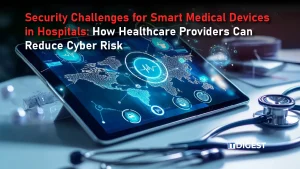
Connected medical devices are transforming healthcare delivery, but they are also expanding the cyberattack surface for hospitals and healthcare providers. From patient monitoring systems to smart diagnostic tools, these devices often operate in highly sensitive environments with strict uptime requirements. To reduce cyber risk, healthcare organizations must adopt stronger security frameworks, continuous monitoring, device segmentation, and proactive threat management strategies. As digital healthcare ecosystems grow, securing smart medical infrastructure will remain a critical priority.