

For years, healthcare AI was stuck in the pilot phase. One tool for scans. Another for patient scheduling. Another buried inside an EHR. Useful, perhaps, but disconnected.
That is beginning to change in 2026. AI is starting to move into the wider operating system of healthcare, tying clinical information with day to day workflows, documentation, decision support, and also the administrative work. The shift is happening because healthcare organizations have very little slack left for inefficiency. Clinicians are overloaded, and paperwork just keeps chewing up care time, while patients are expecting faster kind of treatment, more personalized attention, all the time.
The clearest answer to how is AI transforming the healthcare industry is therefore not a single breakthrough. It is the gradual movement from isolated AI tools toward connected intelligence that can help predict risks, support clinicians, automate routine work, and make healthcare more responsive.
1. Revolutionizing Diagnostics and Personalized Precision Medicine
One of the biggest changes is happening where healthcare starts, with finding out what is wrong with a patient.
Doctors already have access to enormous amounts of information. A scan sits in one system. Lab results sit somewhere else. Patient history may stretch across years of records. Genetic information can add another layer. The challenge is connecting all of it without making a clinician spend hours looking for the signal buried inside the noise.
AI is becoming useful precisely because it can process these different information streams much faster.
Multimodal Diagnostic Imaging and Early Disease Detection
Modern AI systems can examine medical images while also drawing context from patient records, laboratory results, and other clinical information. That matters because diseases rarely present themselves as one clean data point.
Cancer is a good example. A suspect region on a scan could mean something way different depending on what the patient went through, and on other clinical signals that come up. AI can sort of glue those bits together, kind of stitch the context, and then point out recurring cues that feel like they should be re-checked, again.
Google’s March 2026 breast cancer research, shows why this stuff matters. Their AI system looked through mammograms from about 125,000 women and it caught roughly 25% of interval cancers that had been overlooked before. Another report, with more than 50,000 women, suggested there can be an estimated 40% cut in screening effort when AI is used as a second reader.
The phrase ‘second reader’ is important here.
There is a tendency to frame medical AI as a contest between doctors and machines. That is the wrong lens. In a real clinical setting, an AI system can flag something, while the radiologist decides whether that finding makes sense. The human still owns the judgement.
That model is much more useful than replacement. AI becomes another pair of eyes, particularly when clinicians are dealing with large volumes of images and limited time.
Precision Therapeutics and Genomic Personalization
 Diagnosis is only half the story. The next question is what treatment makes sense for this particular patient.
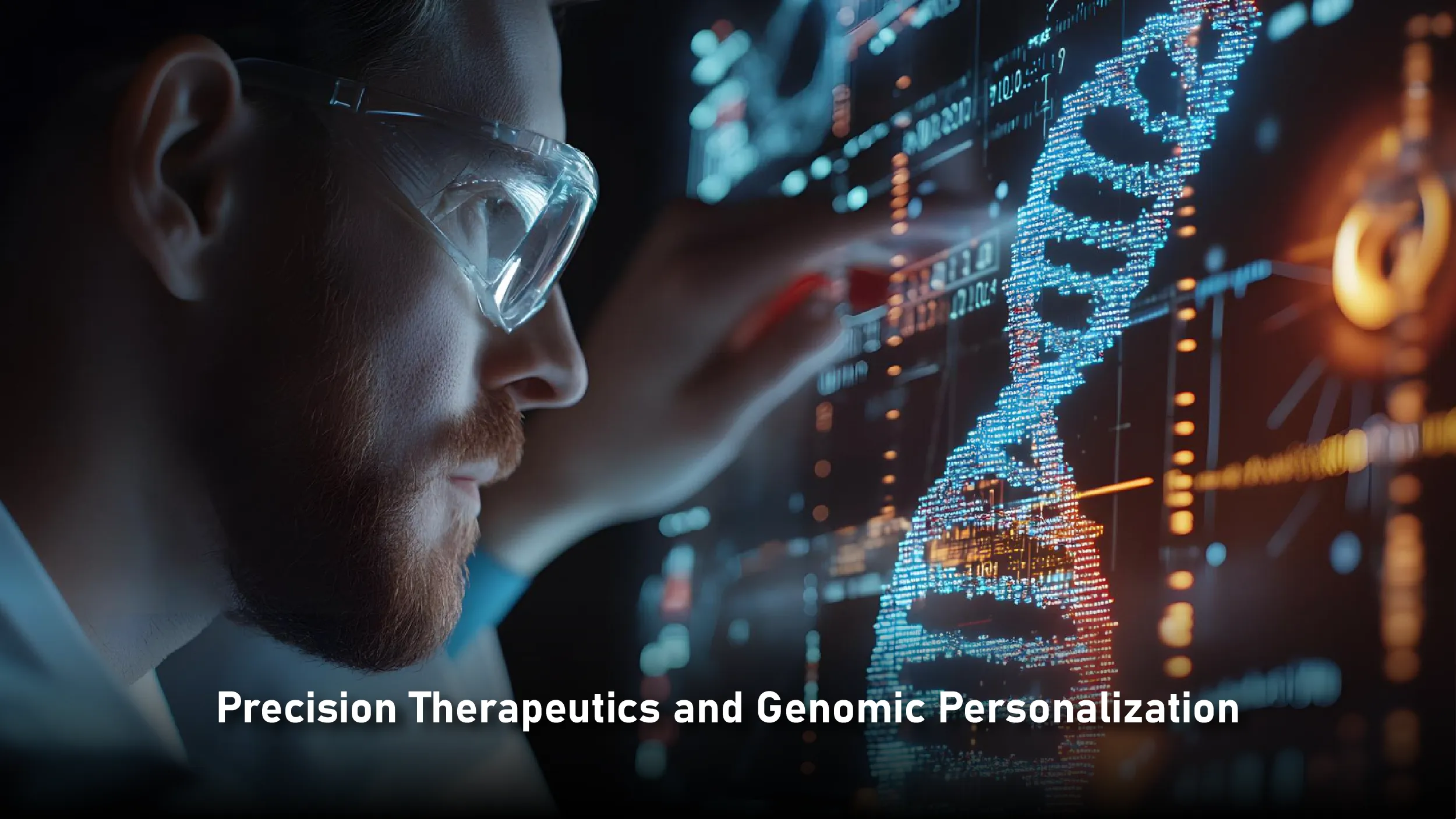
AI can bring together a patient’s past medical record, biometric cues, lab readings, and genomic profiles, so clinicians can spot treatment patterns that would otherwise take ages to sort through. In theory, this can allow more accurate decisions about therapy and dosage, while also cutting down the odds of exposing patients to treatments that don’t really match their own individual set of traits.
This is where personalized medicine becomes more than a buzzword.
The promise is not simply better prediction. It is better matching. A treatment decision can take more of the patient’s actual biology and history into account instead of relying primarily on broad population-level patterns.
That does not remove the clinician from the process. It gives the clinician a richer information base to work with.
Also Read: Telehealth Implementation Guide: How Healthcare Organizations Can Build Secure, Scalable Virtual Care Services
2. Streamlining Clinical Workflows and Mitigating Physician Burnout
There is another part of healthcare where AI can have an immediate effect, and it has nothing to do with diagnosing disease.
It is paperwork.
A clinician can spend a large part of the working day documenting what happened during a consultation instead of focusing entirely on the person sitting in front of them. The EHR was supposed to make information easier to manage. In many cases, it also created another administrative burden.
Ambient Intelligence and Automated EHR Documentation
Ambient AI takes a different approach.
During a consultation, voice-enabled systems can capture the conversation, identify clinically relevant information, and turn it into a structured draft for the EHR. Depending on the workflow, that can include clinical notes, orders, and coding suggestions. The clinician reviews the output before it becomes part of the record.
That last step matters. Automation without review is not a shortcut. It is a liability.
Microsoft reports that clinicians at Cooper University Health Care using AI-powered clinical documentation saved more than four minutes per patient visit on documentation. The organization also reported less burnout and more meaningful patient engagement.
Four minutes may not sound dramatic on its own. Across a day of consultations, however, it changes the equation.
The three practical benefits are fairly straightforward:
- More direct eye contact because clinicians are not constantly switching between the patient and a keyboard.
- Less ‘pajama time’ because documentation does not have to spill as heavily into the evening.
- Faster review of patient information because relevant details can be organized instead of manually reconstructed.
Clinical Decision Support Systems at the Point of Care
Documentation is only one part of the workflow.
AI can also assist clinicians in working through complicated information right at the point of care. Medical literature, prior diagnoses, lab histories, medications, and other records might feel hard to take in fast, particularly when the situation is complicated.
A capable decision support system can bring forward the most relevant evidence, spot patterns within a patient’s history, and propose some plausible differentials, or even care pathways for the clinician to check and evaluate.
Again, the distinction matters.
The goal should not be to create a machine that says, ‘This is the diagnosis.’ The more useful model is a system that says, ‘These are the patterns, evidence, and possibilities you may want to consider.’
That changes the role of AI from decision-maker to decision support. It also makes adoption easier to trust because the clinician remains accountable for the final call.
3. Driving Enterprise Operational Efficiency and Financial Health
 Healthcare does not run on clinical care alone. Behind every consultation is an enormous operational machine involving insurance, coding, scheduling, staffing, beds, supplies, and payments.
For years, many of these processes have been handled through fragmented software and manual handoffs. That is an obvious target for AI.
Automating the Administrative Backbone
AI can verify insurance eligibility, support prior authorization, identify potential billing-code errors, and reduce the amount of repetitive work involved in revenue-cycle processes.
AWS is already moving in this direction. In 2026, it launched Amazon Connect Health with five healthcare AI agents covering patient verification, appointment management, patient insights, ambient documentation, and medical coding.
The system can verify insurance eligibility in real time. It can capture patient-clinician conversations and generate notes. It can also generate ICD-10 and CPT codes and connect these functions with EHR and clinician-facing applications.
The significance is bigger than any individual feature.
These are tasks that sit at different points in the healthcare journey but depend on the same underlying information. When AI can move that information between workflows, organizations have a chance to remove some of the friction created by manual handoffs.
Predicting Demand Before It Becomes a Problem
The same logic applies to capacity planning, in a way.
Hospitals can’t really wait until the emergency department is already overcrowded, to realize they need more staff, or extra beds. Predictive analytics can look through historical admission patterns, appointment calendars, seasonal surges and a bunch of other operational signals, to help the teams sense the squeeze before it actually arrives.
Then the practical course of action might be to move staffing levels around, have beds standing by, adjust the appointment schedules, or shift resources in advance, before the demand wave tops out.
That is a very different idea of automation.
It is not about making a hospital run with fewer people at any cost. It is about giving the people running it enough visibility to make decisions before the situation becomes urgent.
This is where AI starts to look less like a clinical tool and more like an operating layer for the healthcare organization.
4. Navigating Ethics, Responsible AI Governance and Global Equity
The technology is moving quickly. Governance is not moving at the same speed.
That gap deserves more attention, because healthcare is not some kind of sandbox environment where an inaccurate AI output is just, a minor inconvenience. A bad recommendation can mess with a diagnosis. It can steer treatment decisions or even impact a patients’ access to care.
WHO Europe reported in July 2026 that only 8% of countries in the WHO European Region had a health-specific AI strategy, which feels rather thin on the ground really.
That figure becomes more striking when placed against the speed of deployment. It suggests that healthcare systems can be adopting AI before they have fully worked out how they want to govern it.
There is also the problem of data.
If the data used to develop an AI system does not adequately represent different populations, the system may perform unevenly. Privacy creates another challenge because healthcare AI often operates around highly sensitive patient information. And even when a model performs well, clinicians still need to understand when its output should be trusted and when it needs to be challenged.
A practical responsible AI checklist should therefore cover three things:
- Clinicians need to understand what the system is doing, where it can fail, and what evidence supports its output.
- Data privacy. Patient Health Information needs strong controls throughout the AI workflow, particularly when cloud-based systems and external models are involved.
- Human oversight. AI should support clinical judgement, not quietly replace it.
The uncomfortable truth is that healthcare does not get to choose between innovation and governance. It needs both.
The Road Ahead and a Strategic Vision for Healthcare Leaders
The real question is, no longer whether healthcare should use AI. That whole debate is already going out of date. The trickier issue is where AI actually improves care, and where it just piles on yet another layer of tech, you know.
Healthcare leaders should push back on the urge to chase every new model or agent. Instead, a better route is to begin with the workflow, not the shiny tool. Look for where clinicians lose minutes, where patients get pushed back or wait around, where admin duties create little choke points, and where decisions depend on information that’s scattered across systems in a not so obvious way.
Then build from there.
How is AI transforming the healthcare industry will ultimately be judged by outcomes, not the number of AI tools a hospital deploys. Better infrastructure matters. Governance matters. So does keeping clinicians involved.
The organizations that get this right will not be the ones that automate the most. They will be the ones that use AI to make healthcare more human, not less.
