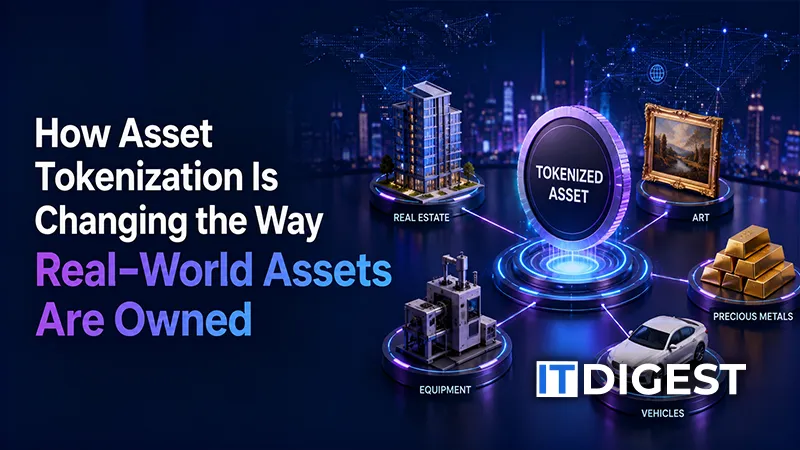
Ownership of real-world assets has traditionally depended on physical documents, legal agreements, centralized records, and intermediaries. There are many types of assets that can be held, and they can involve complex processes to purchase, sell, manage, and transfer.Real estate, precious metals, artwork, investment funds, others can all be involved in complex processes for the purchase, sale, management and transfers of investments.
There is a new model with the arrival of asset tokenization. It is the process of creating digital tokens that represent rights, ownership interests or claims to economic value that are associated with real-world assets. These tokens can facilitate fractional participation, digital records and better transfers depending on the structure.
As blockchain technology advances, the tokenization of assets may revolutionize how people and businesses do business with traditionally illiquid assets that are hard to access.
What Is Asset Tokenization?
The process of creating the digital copy of certificates of rights or interests for a real-world asset is called asset tokenization. The underlying asset could be a property, commodity, artwork, investment fund, or another type of valuable asset.
The tokens are typically recorded on a blockchain. This makes it possible to have a digital trace of transactions and token ownership. There are also some pre-defined activities in relation to the tokens that can be automated by smart contracts.
It is important to note that while tokenizing the format can be used to represent the physical asset, that does not necessarily provide direct legal ownership of the physical asset. What rights the token holder actually acquires is determined by the legal structure. This right may be by way of ownership, equity in the company, accrual rights, or another contractual relationship.
How Traditional Asset Ownership Works
Building manual rights are frequently given in a series of administrative processes. The ownership of any property may involve legal documents, government records, financial institutions and brokers and other intermediaries.
Complications may arise if an asset must be shared among multiple participants. Other assets, as well, have high initial investments, making them inaccessible for those with smaller budgets.
Additional documentation, verification, settlement, fees may apply to transfers. All these factors can limit the liquidity of real-world assets as compared to digital financial assets.
The goal of tokenization is to modernize some such processes by digitizing what are traditionally defined asset-related rights.
Also Read: Top SonarQube Alternatives for Enterprise SAST in 2026
How Tokenization Can Change Asset Ownership
Fractional Ownership
Fractional participation is one of the often-mentioned aspects of tokenization. A valuable asset may be breakable and able to be split up into smaller digital components.
The number of tokens that represent a property may be the number of interests that are defined in that underlying property. The asset may not be held by one participant, but others have smaller interests in the asset.
This may reduce the barriers for participation in relation to some assets. The rights of fractional ownership, however, will be contingent on its legal structure, regulatory requirements, and the rights that come with the tokens.
Digital Ownership Records
Blockchain technology can help to create a common digital ledger of token transaction history. A blockchain can, unlike existing record-keeping systems, record transactions following a codified set of rules of the network.
This can help to create greater transparency and better trackability of ownership records. This system’s effectiveness still depends on how accurate the information that is linked to the blockchain is.
More Efficient Transfers
Interests can be transferable via digital systems. This may make transfer of assets simpler for some administrative processes.
But not all transfers are unrestricted, nor is digital transfer. There may be identity verification requirements, investor eligibility for regulatory requirements and platform rules.
Programmable Ownership
Smart contracts can add “programmable” elements to tokenized assets. They are able to perform pre-stored programs at certain conditions.
For instance, a smart contract might be capable of a lot of automation in distribution, restriction of transfers, or dictating transaction conditions. This can minimize manual work in appropriate processes.
Which Real-World Assets Can Be Tokenized?
When legal and technical structures are available, tokenization can be used for other assets.
One discussed use case is for real estate, where it may have high valuations and be illiquid. Defined interests may be digitally represented in relation to property related structures through tokenization.
Additionally, precious metals may be linked to tokenization models oriented toward a clear claim or interest related to assets deposited in the holding accounts.
Private credit, investment funds, artwork, collectibles, commodities, infrastructure and energy assets may also be wrapped-up in this context.
The answer is that not all assets could be considered appropriate for tokenization. Legal ownership, valuation, custody, regulation, investors’ demand and market ready-ness should all be taken into account.
Potential Benefits of Tokenized Ownership
Greater Accessibility
Some assets can be tokenized to be split up into smaller digital parts. This can provide greater access to asset classes which are normally only open to participants with a fairly large amount of capital. But the participation is subject to asset structure and applicable regulations.
Improved Transparency
Records of transactions and shifts in tokens’ ownership can be kept consistent via the blockchain. Depending on the design of the platform and blockchain, participants can potentially follow the activity that they are interested in in a shared digital record.
Greater Administrative Efficiency
Ownership and transactions under tokenized structures may be digitized. This can help to minimise manual workload, enhance record keeping and make reconciling various different actors in asset management easier.
Potential Liquidity
Tokenization can pave the way for further possibilities of interest transfer in specific assets. Without denying the need for a compliant secondary market, if one can be established, then the trading of tokenised interests may be more efficient than trading with some traditional asset interests. But just tokenization isn’t enough for liquidity.
Process Automation
Smart contracts can automatically take action when certain conditions are met. They can, for instance, facilitate distributions, transfer rules, or other types of transactions. This might help to minimise manual involvement in appropriate instances.
The Future of Real-World Asset Ownership
Traditional asset ownership with blockchain-based infrastructure could form the future asset ownership. In the years to come, with developing regulatory environments and technology, more companies may consider using technology to provide digital representation of real world asset interests.
But, successful tokenization calls for so much more than just generating a digital token. The underlying asset, rights, compliance, technology and asset management processes must be tied to the model.
Evidence of more institutional involvement and improved regulation may also shape the rate by which tokenized assets will gain to the financial mainstream.
As the tokenization ecosystem develops, white label tokenization platform development may provide businesses with an approach to building customized tokenization infrastructure. The structures on such sites are appropriate for a variety of asset types, regulatory requirements, compliance procedures, and the planned rather than trading with structures.
Conclusion
The asset tokenization concept is reshaping the nature of real-world assets representation, management, and transfer. It could enable fractional participation, greater transparency, automated processes, and more streamlined transfers, thanks to a combination of blockchain records, digital tokens, and smart contracts.
Concurrently, tokenization does not take the place of law or regulatory obligations, or investor safeguards. The adoption of the technology will be key to its longevity if the technology complements existing financial and legal frameworks.
These frameworks are still in development and tokenization is a likely part of the changing model of ownership in a real-world asset.