

The metaverse had a noisy start. Gaming, virtual concerts, digital avatars and flashy virtual worlds dominated the conversation. It was easy for business leaders to dismiss it as another technology trend looking for a problem to solve. The enterprise story is different.
Today, enterprise metaverse applications are taking shape where digital and physical operations meet. Digital twins can mirror factories and supply chains. AR and VR can place employees inside realistic training environments, while IoT and AI can keep those environments connected to live business data.
The real question is no longer whether a company should ‘enter the metaverse.’ It is where immersive technology can remove friction, reduce risk or improve decisions. This article examines use cases, ROI, challenges and a practical framework for getting started.
What Are Enterprise Metaverse Applications?
Enterprise metaverse applications let people enter a digital space and still stay tied to real work. These spaces are made to link to company data and day to day tasks. They also need to account for physical gear, set workflows, and follow security rules. For this reason, they are not built like games or typical consumer virtual worlds.
The World Economic Forum says organizations need to coordinate people, data and workflows to scale combinations of AI, spatial intelligence, robotics and digital twins. The enterprise metaverse is not one technology.
The core technologies behind enterprise metaverse applications include:
- Digital twins create virtual replicas of physical assets, facilities, products or processes. They allow teams to test changes before physical deployment.
- Spatial computing through AR, VR and MR gives employees a more direct way to interact with 3D information and digital environments.
- IoT and AI provide the data and intelligence needed to update simulations, identify patterns and support real-time decisions.
The result is a different kind of workflow. Instead of forcing a 2D process into a 3D interface, businesses can use spatial environments where physical context becomes part of the work.
Also Read: Microservices Architecture for Enterprise: A Practical Guide to Building Scalable and Resilient Applications
4 Key Enterprise Metaverse Use Cases Transforming Operations
Immersive Employee Training and Onboarding
Training becomes harder when the cost of failure is high. A technician working around heavy machinery cannot always learn through trial and error. A virtual environment can recreate the task and let employees practice before facing the real situation.
Meta’s 2026 developer documentation positions enterprise mixed reality for business operations, training and customer experiences. That shows where enterprise metaverse applications are becoming practical. The value of enterprise metaverse applications is not the headset. It is the ability to repeat a task, understand a physical environment and build familiarity without unnecessary risk.
Accenture’s Nth Floor and Walmart’s use of VR training show how large organizations have explored immersive learning. Once built, a training environment can be reused across teams and locations.
Digital Twins in Manufacturing and Supply Chain
This is where enterprise metaverse applications become more operational. A digital twin can represent a factory, production line, machine or supply network and let teams test decisions before making them physically.
Manufacturers can use these environments for facility planning, predictive maintenance and process simulation. A virtual factory can expose layout problems before construction or show how one process may affect another. The same thinking extends across warehouses, inventory, transport and suppliers.
Google Cloud’s June 2026 example shows how a digital twin can model a food supply chain by representing interconnected assets, inventory, locations and dependencies. Teams can use that model to trace risks, examine the impact of disruptions and explore possible responses. The digital twin is no longer just a 3D copy. It becomes a decision-making environment.
Borderless Collaboration and Virtual Workspaces
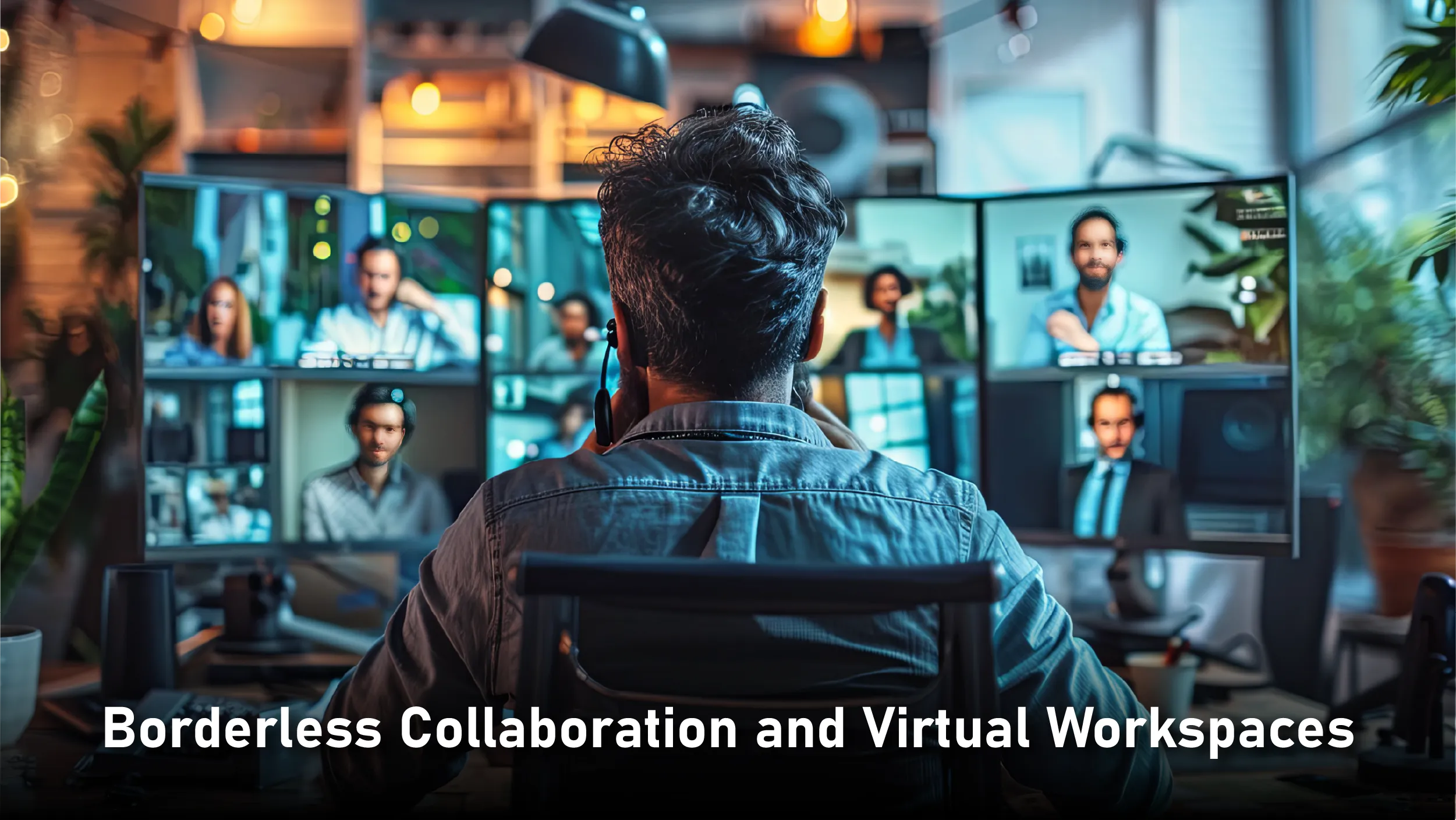 Remote collaboration solved distance, but not every problem of working together. A video call works well for discussion. It becomes less useful when teams need to inspect a machine, review a 3D product or work through a physical environment together.
Spatial audio, 3D models and shared virtual spaces can make those activities more natural. Designers in different locations can examine the same product model. Engineers can walk through a virtual facility. Field teams can share what they see with specialists elsewhere.
That does not mean every meeting needs a headset. Using immersive technology for a simple status call can create more friction than it removes. The stronger case is where the work has a spatial or physical dimension.
Next-Gen Customer Experiences and Virtual Showrooms
Enterprise metaverse applications can also change how complex products are sold. A customer considering expensive machinery may want to see how it fits into a facility, operates and changes across configurations before making a major purchase.
A virtual showroom can bring those possibilities into a controlled digital environment. Sales teams can demonstrate equipment, change configurations and walk buyers through scenarios without moving machinery between locations.
The advantage is clarity. When a product is complex, seeing it in context can make the buying conversation more useful than another deck.
The Tangible Business Value and Measuring the ROI
 The business case gets stronger when companies measure operational outcomes. Time saved, physical testing avoided and earlier decisions matter more than visits to a virtual environment.
Microsoft reports that Krones reduced computer-simulation run times from three to four hours to five minutes or less, representing a reduction of up to 98%, after combining AI agents, Azure high-performance computing and physically accurate digital twins.
That changes the ROI conversation. The value comes from compressing the time between a question and an answer. Engineers can test more scenarios without waiting hours for each simulation, before physical resources are committed.
| Business factor | Traditional methods | Metaverse applications |
| Cost | Physical prototypes, travel and repeated testing can add expense | Digital simulation can reduce the need for some physical iterations |
| Speed | Testing depends on physical setup and availability | Virtual scenarios can be evaluated before physical deployment |
| Safety | Some training and testing must happen in real environments | High-risk scenarios can be practiced or assessed virtually first |
| Collaboration | Teams often rely on screens, documents and separate models | Distributed teams can work around shared 3D environments |
| Decision-making | Changes may be tested after physical resources are committed | Digital twins can support earlier scenario testing |
The important shift is from treating the metaverse as a marketing expense to treating it as an operational tool. That distinction will decide whether enterprise metaverse applications survive beyond the pilot stage.
Overcoming the Hurdles and Implementation Challenges
The technology still has rough edges. Security is one. A digital environment connected to factory systems, customer information or intellectual property cannot be treated like a gaming platform. Access controls, data protection and ownership rules need to be built into the architecture.
Infrastructure is another issue. Immersive applications need reliable connectivity, computing power and comfortable devices. Industrial systems may also need to connect with IoT devices, edge environments and operational technology.
Then there is the human problem, which technology vendors often underplay. Employees may resist a workflow if they cannot see why it is better. A technically impressive virtual environment can still fail if it adds steps or does not fit how people work.
Integration is therefore the real test. Enterprise metaverse applications should connect with systems that already run the business rather than become another isolated stack. ERP, CRM, product lifecycle management, IoT and operational systems all need a clear role.
A Strategic Framework for Enterprise Adoption
A sensible enterprise metaverse strategy starts with the problem, not the technology.
Step 1 is to identify high-friction areas. Look for processes where physical testing, distance, complexity or risk slows the business down. A simple meeting does not need VR. Complex 3D modelling or equipment training may justify it.
Step 2 is to run a focused pilot. Pick one workflow, establish a baseline and measure what changes. The goal is not to prove that the technology is exciting. It is to prove that it improves a business process.
Step 3 is to connect the pilot to existing systems. AWS’s 2026 industrial AI demonstration follows a simulation-first sequence of building the digital twin, validating it in simulation and then deploying it to physical hardware. That approach helps address the gap between digital testing and real-world execution.
The lesson is simple. Do not build a virtual world and then search for a reason to use it. Find the operational bottleneck first.
Conclusion
The enterprise metaverse is becoming less about virtual worlds and more about connections between physical operations and digital intelligence. That makes it easier to evaluate, but it also raises the bar. A 3D environment alone does not create business value. Value appears when it helps people train safely, test decisions earlier, collaborate around complex information or understand difficult physical systems.
That is why enterprise metaverse applications should be assessed like any other business investment. Start with the bottleneck, define the outcome and measure the change. If the technology solves a real operational problem, the immersive layer has a reason to stay.
