

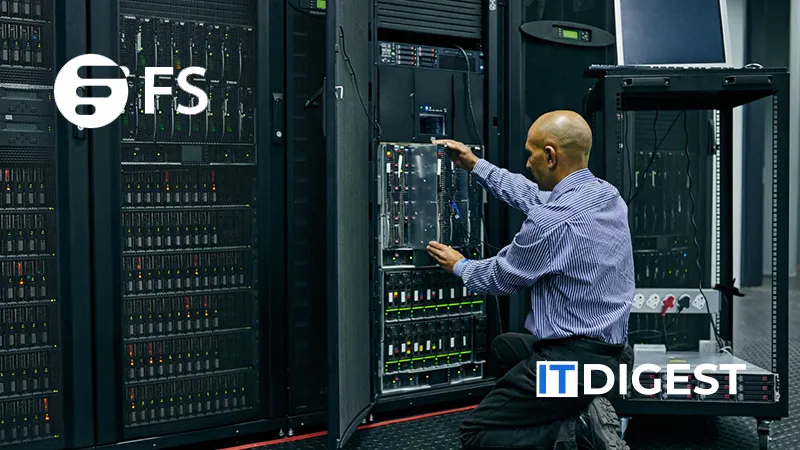
Rapid proliferation of AI, high-performance computing, and cloud-based applications has resulted in an unprecedented demand for data center bandwidth. With increasing complexity of AI models, the data centers can no longer be siloed in their operations and have to rely on large amounts of ultra-low latency inter-site connectivity to coordinate training clusters and load inference operations.
In order to cope with such increasing demands for inter-site throughput, the network infrastructure company FS launched D7070 series Integrated 800G Muxponder and thus extended its DCI product lineup to 800G line capacity.
The 1U platform consolidates the current 100 GbE and 400GbE client services into four 800G coherent waves, providing 3.2 Tb/s aggregate line capacity across data centers, metro and regional networks. This launch is an important step for the Optical Networking, Telecommunications and Data Center Infrastructure industries, allowing scaling 800G transport into a flexible and open software architecture.
Technical Performance: High-Density 800G Aggregation in a 1U Footprint
The primary engineering achievement behind the D7070 Series is its ability to maximize wavelength efficiency while maintaining low power consumption and flexible multi-rate compatibility. By leveraging 800G CFP2-DCO coherent line modules alongside 800G ZR Tunable DWDM optics, the system enables operators to move high-capacity traffic across dense wavelength-division multiplexing (DWDM) infrastructure without requiring a complete overhaul of lower-rate client interfaces.
Also Read: Cloudera and NVIDIA Partner to Accelerate Apache Spark Pipelines and Slash Cloud Compute Spend
The platform introduces several key operational capabilities:
Flexible Multi-Service Aggregation: Accommodates 100G QSFP28 and 400G QSFP112 client pluggables, allowing network operators to pool legacy client links into high-speed 800G trunks.
Open Architecture & Multivendor Management: Features standardized WebGUI and CLI management interfaces designed to integrate seamlessly with third-party Network Management Systems (NMS), preventing vendor lock-in.
Comprehensive DCI Spectrum: Completes an optical transport portfolio spanning rapid 100G point-to-point links (D5110), encrypted 200G OTN transport (D710), compact 400G ZR/ZR+ deployments (D6000), and high-capacity metro transport (D7000).
Transforming the Optical Networking and Telecommunications Industry
The migration of 800G coherent optics from specialized high-end routing cores to versatile DCI muxponders accelerates major structural shifts across the optical transport vendor landscape.
The Shift Toward Coherent Plug-and-Play DCI
For over a decade, scaling inter-data-center bandwidth required deploying complex, proprietary optical line systems that demanded specialized optical engineering teams.
FS’s rollout of an open, pluggable-based 800G muxponder reflects the industry’s transition toward coherent modular transport. By pairing standardized 800ZR/ZR+ technology with standardized management interfaces, optical networking is shifting from closed ecosystem hardware to open, interoperable architectures.
Aligning Transport Infrastructure with AI “Scale-Across” Demands
Historically, data center networking focused on “scale-up” (adding compute inside a chassis) or “scale-out” (adding servers within a hall). The rise of distributed multi-gigawatt AI clusters has popularized scale-across architectures, where multiple physical facilities function as a single logical data center.
Muxponder innovations like the D7070 elevate optical transport from a background utility into a core component of the AI technology stack. Telecommunications providers and cloud service providers (CSPs) are increasingly evaluated on how quickly and efficiently they can deliver high-capacity optical interconnects between distributed compute nodes.
Broad Operational Impact on Enterprise Businesses
For cloud hyperscalers, telecommunications operators, and enterprise IT leads managing bandwidth-intensive applications, adopting 800G DCI transport offers distinct operational and financial advantages:
Protecting Operating Margins Through Capital Efficiency
Deploying physical dark fiber on a regional scale is one of the most capital-intensive elements in network engineering. By Really increasing the throughput per wavelength on existing fiber lines, the need for more fiber leases or civil construction is avoided resulting in protection of the operating margin.
Running Real-Time Hybrid Cloud and AI
When a facility has issues with inter-facility latency or bandwidth, the distributed database synchronization is delayed and the AI model training gets stalled. Deploying high- density 800G optical interconnects ensures there is smooth running of business data across hybrid clouds enabling running of real-time analytics, distributed AI inference, and automated disaster recovery operations without network performance degradation.