

The technology can be sound and we work with clinical, IT, and operational stakeholders to design new development, but if it doesn’t map to how people actually behave when they’re anxious, overwhelmed, or navigating an unfamiliar system, it won’t do what you built it to do. That’s why those immersion trips are so important!
Borno, you’ve spent more than 15 years at Epic, moving from software development into team leadership while staying close to healthcare technology. What early lesson still shapes how you decide what a healthcare product should solve?
At Epic, we never really move out of development. Part of my job is staying close to where the industry is heading, not just writing code but setting direction for what we develop next to help patients. One thing I’ve learned is that it’s important to know what’s happening on the ground how staff communicate, what patients are confused by, where the friction is in a real clinical environment. That grounding shapes every product decision I make. Epic expects all developers, from day one onward, to complete immersion trips every year. These were helpful early in my career to gain a stronger practical understanding of how my development impacts real patients’ lives, and that learning has continued to grow over time.
You’ve seen healthcare software evolve from core clinical applications and digital records toward connected patient experiences and AI. What has that journey taught you about the difference between building software that works and building software that genuinely works for the people using it?
You have to get out of the building. For me, that means time in clinics with doctors and nurses, and it means working directly with patients. And everyone has firsthand or secondhand experience as a patient, and that experience is one of the most honest lenses you can bring to product development. The technology can be sound and we work with clinical, IT, and operational stakeholders to design new development, but if it doesn’t map to how people actually behave when they’re anxious, overwhelmed, or navigating an unfamiliar system, it won’t do what you built it to do. That’s why those immersion trips are so important!
Your work has increasingly moved closer to the patient experience through products such as MyChart Bedside. What changed in the way you think about engineering when the person on the other side of the product became a patient navigating an unfamiliar or vulnerable moment?
Patient experience has always been the core of what we build. I grew up professionally on our MyChart team, and one thing that has sharpened my thinking over time is scale. We have more than 195 million MyChart users today, and that means both volume and diversity of needs. Someone managing a routine primary care visit, someone coordinating cancer care for a family member, and someone recovering from surgery are all using the same platform and when someone finds themselves in an unfamiliar or vulnerable moment, familiarity can be one of the things that sets them at ease. That’s what keeps me going.
A 2026 study using Epic Cosmos data found that patient-authored portal messages increased 153% between 2020 and 2025. As digital communication becomes more central to care, what needs to change so greater patient access does not simply translate into greater workload for care teams?
MyChart has always been a self-service engine, patients don’t want to wait on hold for ten minutes to get a simple answer, and they shouldn’t have to. The opportunity ahead is broader adoption of patient self-service for the interactions that still default to a phone call or a staff member, like scheduling an appointment. Emmie represents a meaningful step in that direction, too by helping patients get answers quickly, it allows access and efficiency to improve together without trading off against each other.
Your work with Hello World has taken patient communication beyond the portal into SMS and voice, with newer capabilities designed to help patients recognize healthcare calls. What has building these experiences taught you about the role trust plays in getting patients to actually respond to technology?
First, don’t overcommunicate. Set expectations with patients so they know what’s coming and why. Second, make every message genuinely useful and easy to act on. A two-line message with a yes-or-no question is much more likely to get a response than a verbose notification. Third, respect preferences. If a patient doesn’t want text messages, sending them text messages doesn’t help anyone. Hello World draws communication preferences from a patient’s medical record, and we also personalize timing someone who tends to engage with their phone in the evening is less likely to respond to a lunchtime message. That level of personalization is what earns the kind of trust that makes patients more likely to respond the next time.
You’ve worked on products where the technology can be complex, but the experience needs to feel simple. What signals tell you that a new feature has removed meaningful friction for patients rather than simply added another digital capability?
Interaction rates are the clearest signal. The distinction between a patient replying within 10 minutes and not taking action on it at all tells you a lot. That applies whether you’re talking about a text message, a prompt in MyChart, or anything else we build. Action tells you the feature fit into something the patient was ready and willing to do.
You’ve also been closely involved in Epic’s patient-facing AI work, including Emmie, which is moving beyond answering questions toward helping patients understand what to do next. What separates an AI system that can generate a good answer from one that can genuinely understand its place in a patient’s healthcare journey?
Tens of millions of people are already asking general-purpose chatbots health questions. But that chatbot doesn’t know that you had a procedure last month, that your lab results came back yesterday, that your cardiologist wants to see you in six weeks, or that you still haven’t scheduled that appointment.
What sets Emmie apart is that it works from the patient’s own chart, so it can account for what comes before and after the conversation. Before a visit, Emmie can ask patients what they want to talk about and share that with the clinician, so both arrive with the same understanding. Afterward, it helps patients finish the tasks that came out of the visit. It’s one step in a connected journey.
After more than a decade as a software developer and team lead in healthcare, how has your definition of a good engineering decision changed when reliability, usability, and performance can ultimately affect someone’s care?
One thing is that our responsibility doesn’t end when we release software. We’re also responsible for how it performs in the real world, how it holds up when something outside your control goes wrong, and how quickly you can support customers and patients during those moments. You have to build for resilience, redundancy, and observability, not just for functionality.
The second is a simpler principle that’s easy to forget under pressure: less is more. The best solutions tend to be the simpler ones, and simpler systems are more reliable systems.
You’ve watched healthcare technology move from digitizing information to connecting experiences, automating communication, and now introducing AI into the patient journey. What problem still feels surprisingly unsolved to you, and what would you personally enjoy helping solve next?
I’ll start with the one that has nothing to do with healthcare: conference room AV. Screen sharing should not still be this hard.
In all seriousness, as a longtime MyChart fan, it still surprises me how many appointments are still booked over the phone, which requires significant staff time and makes patients wait. But patients who prefer the phone should be able to use it without those burdens. We’re working on letting Emmie handle those calls answering, scheduling, rescheduling so patients get what they need quickly and staff can direct their attention to where it matters most. Branded Calling helps phone-first patients too, by letting them see when a call is really from the health system they know and trust. That’s the part of this work I enjoy most: helping health systems meet patients where they are, however, they prefer to communicate.
Thanks Borno!
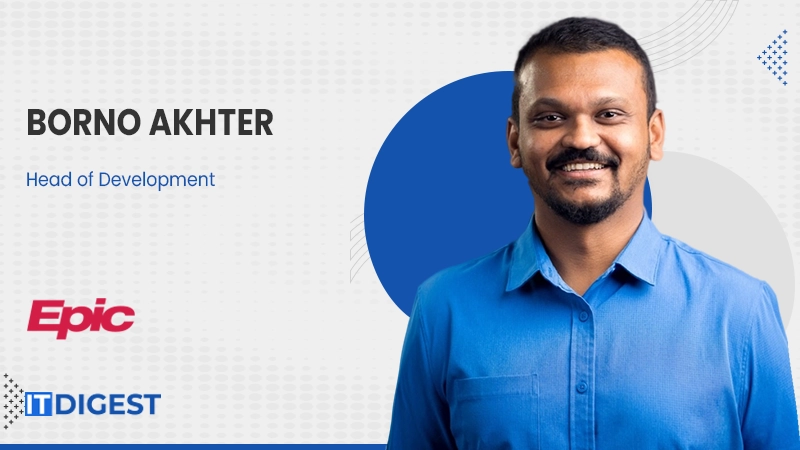
Borno Akhter leads the development of Hello World at Epic, focusing on technology that enables healthcare organizations to improve patient engagement through automated communication and outreach. His work spans patient messaging, appointment reminders, confirmations, and rescheduling, helping health systems deliver more timely and effective patient communications. Akhter is also involved in Epic’s collaboration with Vonage to enhance patient engagement through branded calling and communication solutions.
Epic develops healthcare technology that connects patients, providers, and healthcare organizations to improve care and outcomes. Its electronic health record and digital health solutions help streamline healthcare delivery, connect critical information, and create better experiences for patients and clinicians worldwide.
Founded in 1979, Epic serves hospitals, clinics, health plans, and other healthcare organizations, with hundreds of millions of patients having an electronic record in its system.