

Governance can’t be a checkpoint that agents wait in line for. It has to travel with the data.
Uma, your career has taken you from electricity transmission operations at Entergy to enterprise AI at C3 AI, strategy at McKinsey, and now global go-to-market leadership at Kore.ai. What has that journey taught you about earning enterprise trust in new technology?
I’ve seen enterprise technology from three seats: as the customer, the vendor, and the advisor. At Entergy, I was responsible for critical transmission operations, and when someone walked in with a new technology, my first question wasn’t what it could do. It was what would happen to the grid, and to the business, if it failed. During my early days at C3 AI, I was the one fielding those same questions, with the responsibility of developing the right products for customers across different sectors. At McKinsey, I was counseling executives on how to plan and execute large scale enterprise transformation projects.
The lesson from all three seats is simple: vendors sell capability, but customers really buy accountability. The excitement about what a technology can do is usually shared. The difference is that the customer is the one who lives with the consequences when it goes wrong. That gap is wider with agentic AI, because agents no longer just inform decisions. They make them and act on them inside core operations. More than 70% of Kore.ai’s customers are in regulated industries, so for us, earning trust starts with seeing the risk the way the customer sees it, and standing behind what we deliver by guaranteeing outcomes.
At Entergy, you worked in an environment where reliability and continuity were critical. What lessons from managing essential infrastructure still shape how you think about deploying AI in business-critical operations?
I co-led restoration work at Entergy after Hurricanes Katrina and Rita, and that’s where I learned what reliability actually means. When the power is out, hospitals, businesses and families are waiting on you. What got us through wasn’t heroics during the storm. It was the planning we’d done long before it. We knew which parts of the network had to come back first, who had the authority to make the calls, and how crews would keep working when the usual systems were down. Our process included a lot of detailed scenario analyses that informed where we would pre-position crews before the storm hit, so they were prepared and ready to begin restoration immediately.
Business-critical AI deserves the same discipline. Before an agent goes live, you should be able to answer three questions: How will it behave when something goes wrong? Who can step in? And how quickly can the work get back on track?
As AI agents move from answering questions to taking action across enterprise systems, the stakes around data access and privacy are changing. What should organizations rethink before allowing agents to work with sensitive information?
The first thing to rethink is identity: whose authority is the agent using? Today, many agents simply inherit the permissions of whoever built or deployed them. That was tolerable when an agent only answered questions. It isn’t when the agent can update a customer’s account, approve a refund or change a record. Now it’s acting on someone else’s authority, and the business needs to be able to say exactly what the agent was allowed to do, who authorized it, and what it actually did.
That means giving each agent its own identity, scoped to its role, with a named owner who is accountable for its behavior and an audit trail that ties every action back to a policy. None of this is new thinking. It’s how we already govern people who handle sensitive data. The mistake is assuming agents can skip it. If an agent is going to touch sensitive customer information, those controls have to be in place before it gets that responsibility, not after the first incident.
Also Read: ITDigest’s Interview With Borno Akhter, Head of Development at Epic Hello World
Gartner’s 2026 research found that only 13% of organizations believed they had appropriate governance in place for AI agents. What separates governance policies that look good on paper from controls that work reliably in live enterprise environments?
Most enterprises already have AI governance policies, and on paper they say the right things. The problem isn’t the policy. It’s enforcement at scale, when you have hundreds of agents, built by different teams, changing every week. Our own research this year found that 79% of enterprises have had to reverse an action an agent took, and 70% have dealt with a failure their teams couldn’t trace. Those organizations had policies. What they lacked was enforcement and visibility.
Two design choices make the difference. First, the rules that can’t be broken shouldn’t be left to the model. Let the model do the reasoning, but enforce critical business rules, eligibility checks and guardrails deterministically, outside the model, so they hold every single time. Second, governance can’t stop at go-live. You need to see what agents are actually doing in production, measure that against your rules and your business goals, and feed what you learn back into the agent. That’s the thinking behind Autoloop, the optimization engine we launched in October. It evaluates agents against real production traces, pinpoints what caused a miss, and scores every fix against all of the agent’s goals, including safety and compliance, so improving one thing never quietly breaks another.
Enterprise agents increasingly need to work across applications, data sources and workflows. How can organizations give them enough access to get useful work done without exposing information or permissions they should never have?
It’s tempting to give agents broad access, because broad access is what makes them useful across applications. But usefulness comes from the right access, not the most access. Even when an agent works across a CRM, a billing system and a knowledge base, access should be managed centrally and scoped to the task in front of it, so sensitive information stays where it belongs.
The bigger distinction is between access and authority. Being able to retrieve information doesn’t mean an agent should be allowed to share it, change it or act on it. In regulated industries especially, leaders should decide, deliberately and in advance, what an agent can do on its own, what needs human approval, and what it should never do at all. Then expand that autonomy as the agent earns it, with evidence, the same way you’d give a new team member more latitude once they’ve proven themselves. The boundaries can move with demonstrated performance, but they should never disappear.
As AI becomes part of everyday business operations, resilience means preparing for more than system outages. Drawing on your experience in critical infrastructure, how should organizations plan for agent errors, disrupted workflows and recovery when something goes wrong?
Critical infrastructure teaches you to plan for the worst case. On the grid, you don’t wait for a failure to figure out your response. You watch for early warning signs, and you have a recovery plan ready. Agents add a harder twist: an agent can complete a task that looks successful while the business outcome is wrong.
So, recovery has to be designed in from the start. Three things matter most. 1) Continuously evaluate real production interactions, not just test cases, so you catch the silent failures. 2) When something does go wrong, contain the impact first and keep the work moving, even if that means handing it to a person. 3) Treat every failure as input: trace it to its root cause, fix precisely that, and verify the fix against your business goals and existing controls before it goes back into production. In our experience, the organizations that recover fastest are the ones that learn fastest.
You led C3 AI’s hyperscaler partnerships and worked across strategic partnerships. As enterprises build AI systems across different models, clouds and business applications, where can partnerships make the biggest difference to security, governance and reliable deployment?
No single vendor can deliver enterprise AI on its own. You have cloud infrastructure, models, agent platforms and business applications, and they all have to work together. But the harder challenge is making them work with what the customer already has. Enterprises have spent years and significant capital on their technology estate. You can’t ask them to rip it out to adopt AI.
Running hyperscale partnerships at C3 AI taught me that “our products integrate” is the easiest sentence in any partnership, and the least meaningful. What matters is whether the partners have worked out, together, how the solution gets deployed, how the customer’s security and governance requirements are met, and who owns what when something breaks. That’s how we approach partnerships at Kore.ai. Our latest platform launched natively on Microsoft Azure, integrated with the identity, security and agent management tools Microsoft customers already rely on. With Atos in the UK, we’re delivering sovereign agentic AI for organizations that need to keep data and control in-country. And because we’re model- and cloud-agnostic, customers keep the freedom to choose, while governance and traceability stay consistent across every agent, whatever it runs on.
You have worked on enterprise AI strategy, pricing and value propositions. When governance, security and resilience require additional investment, how should leaders evaluate their value alongside more visible gains such as productivity and cost savings?
Enterprises need to change how they calculate AI ROI. If we measure agents the way we’ve always measured automation, by tasks completed, hours saved and costs cut, we miss half the ledger. An agent can complete thousands of tasks, but if a handful of them trigger rollbacks, customer remediation or a compliance finding, those gains can disappear quickly.
I’d evaluate governance, security and resilience on three lines. First, risk avoided: the cost of the errors, reversals and incidents that stronger controls prevent. Second, value unlocked: the higher-stakes work agents can take on only because the controls exist, work that would otherwise stay manual. Third, compounding returns: when governance is built into the platform, it becomes shared infrastructure, so the controls you build for your first agent carry over to your hundredth, and each new agent costs less to deploy safely than the last. Put those three lines on the same page as productivity and cost savings, and governance stops looking like a tax. It starts looking like the thing that makes the rest of the business case real.
As Chief Commercial Officer, you bring sales, partnerships, marketing and strategy together at Kore.ai. How does that broader commercial perspective shape the way you help customers balance the promise of agentic AI with concerns about data exposure and operational risk?
Bringing sales, marketing, partnerships and strategy together gives me a clear view of what customers want from AI and what’s holding them back. One shift stands out: AI buying decisions that used to sit within a single department now put the CIO, the CISO and the CFO at the same table. Each is asking a different question: Will it work? Is it safe? Will it pay off? A credible answer has to satisfy all three.
My starting point is always the business outcome, not the technology. Many companies are agentifying workflows without asking whether those processes should exist in their current form. If a process is poorly designed, an agent just helps it fail faster. And once agents are accessing data and taking actions across systems, those flaws become new risks. So, we work with customers to rethink the process first, then decide what data each agent needs, how much autonomy it should have, and where the business must retain control. That’s how you capture the upside of agentic AI without taking on risk you never needed to take.
As AI agents become more deeply embedded in enterprise operations, what will distinguish organizations that scale with confidence from those that struggle to move beyond pilots? And what role do you see Kore.ai playing in that transition?
Too many companies adopt AI before they’ve decided which business problem it should solve. The biggest difference I see is whether an organization makes AI part of its business strategy or treats it as one more automation tool. The organizations that scale start with business goals and rethink how the company operates: redesigning workflows, dividing responsibilities between people and agents, prioritizing investments, managing risk and measuring returns. Those decisions need business leaders to own them. Without that ownership, you can end up with a hundred successful pilots and very little business value.
At Kore.ai, our role is to help customers turn that strategy into production. We start with one high-value use case, define measurable outcomes and bring the right teams together around it. Our platform then builds the agent and its tests from the customer’s own operating procedures, enforces governance before anything goes live, and keeps optimizing against those same goals once it’s in production. The aim is to get that first use case live within weeks, prove the value, and then expand into more complex workflows with the same governance underneath. Scaling with confidence isn’t about deploying more agents. It’s about deploying agents you can trust, measure and improve.
Thanks Uma!
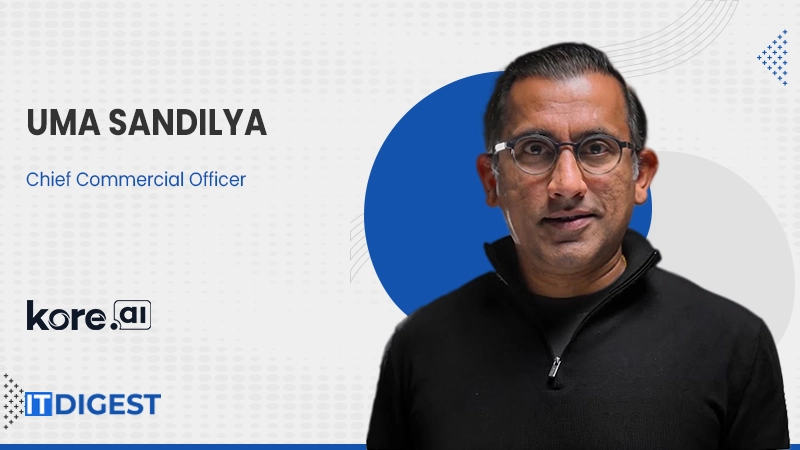
Uma Sandilya is the Chief Commercial Officer at Kore.ai, where he leads the company’s global sales, go-to-market strategy, marketing, business development, and corporate strategy. With more than two decades of experience in enterprise AI and business transformation, he has held senior leadership positions at C3 AI and McKinsey & Company. During his tenure at C3 AI, he played a key role in developing enterprise AI solutions and building strategic partnerships. His expertise spans enterprise AI adoption, revenue growth, strategic alliances, and scaling technology businesses.
Kore.ai is a global enterprise AI company that helps organizations build, deploy, manage, and optimize AI-powered experiences and applications. Its platform enables businesses to leverage conversational AI, generative AI, and agentic AI to automate workflows, improve customer and employee experiences, and accelerate enterprise operations. With capabilities spanning AI agents, intelligent automation, orchestration, and enterprise-grade governance, Kore.ai helps organizations scale AI adoption while maintaining security, reliability, and control.