

Successful, sustained adoption depends on whether the Network API solves a clear business problem, demonstrates measurable results, and fits into existing customer journeys.
Kunal, your career has taken you from software engineering at Motorola and Ericsson to cloud commercialization at Google, SaaS transformation at Digital Barriers, and now Network APIs at Vonage. What early lesson still shapes how you decide whether a promising technology can become a successful business?
I learned early in my career that technical strength alone doesn’t determine whether a product succeeds. A product succeeds when it addresses a real customer need and delivers a result customers can measure in terms of clear ROI. I continue to apply that lesson to how I look to empower customers to develop impactful apps powered by the network. The technical specifications are a minor part of the conversation. The interesting part is the measurable value network intelligence bring to the table: seamless communication across global networks, improved collaboration, high-quality abstracted data with privacy for end users, built-in security, and the ability to bring advanced solutions to market quickly.
You have spent much of your career turning complex infrastructure into solutions that enterprise customers can adopt. As Network APIs make telecom capabilities accessible to developers, what changes in the way businesses can build products and solve customer problems?
Simply put, speed and sophistication. Mobile networks can tell whether a phone number is active, where a device is located, and what kind of device it is. Network-Powered Solutions enable developers to bring those capabilities into the workflows and services they already build. For example, a company sending a work order to a field technician could verify that the phone belongs to the intended person, use location information to assign jobs more efficiently, and make sure the worker can access what they need on site. At Vonage, we want to make network information useful without asking developers to manage the complexity behind it and retain end user data privacy. The goal is to help them deliver outcomes the network has never made available before, built on information operators have always had, but enterprises could never use historically.
In March 2026, the GSMA reported more than 300 commercial deployments of 20 different CAMARA APIs across 65 markets. As Network APIs expand, what do you think will determine whether this growing availability translates into sustained enterprise adoption?
Successful, sustained adoption depends on whether the Network API solves a clear business problem, demonstrates measurable results, and fits into existing customer journeys.
Speed means more than having APIs available, it means having them available nationwide within a market and ultimately across markets globally, so enterprises can build around them with confidence. Simplicity means the capabilities must be straightforward for developers and enterprises to put to work. Fraud is one of the clearest starting points. Platforms like bank websites and online marketplaces risk account takeovers when users sign up, log in or make payments, and network signals can provide a layer of protection to those moments. Field service workflows and connectivity for performance-sensitive work are also strong use cases. And scale depends on businesses having confidence that results are measurable and that their customer and organizational data is handled with consent and in line with local requirements.
Vonage’s work with Freenow by Lyft uses Silent Authentication and SIM Swap detection to strengthen user verification without disrupting booking and payment journeys. What has this kind of real-world deployment taught you about balancing stronger security with a seamless customer experience?
Serving nine markets and more than 180 cities, Freenow by Lyft needs verification that works on every booking without slowing riders down. Riders expect to book and pay in seconds, and any security step that gets in the way puts the experience at risk. We started with the concern around account takeover and SMS fraud, and when we began working on Silent Authentication and SIM Swap detection, we found that beyond preventing fraud, these signals also improved the customer experience by 3-5x, with real business impact on conversion rates.
This deployment taught me that security holds up best at scale when it is built around how customers already use a service. Start with the steps customers find most frustrating, because those are often where verification can move to the network.
As AI makes impersonation and digital fraud more sophisticated, businesses are rethinking how they establish trust online. Where do mobile network signals have the greatest potential to strengthen identity verification, and how should enterprises combine them with their existing security measures?
Mobile network signals provide useful context at moments when a business needs to confirm who it is transacting with, such as account logins, payments or calls to a contact center. If someone calls a bank claiming they have been locked out of an account, the bank could check whether the call is coming from the customer’s phone number and whether the location is consistent with what it knows about them. With AI tools being capable of voice cloning, voice alone isn’t a reliable identity check, so this type of verification is becoming even more essential.
These signals should be one part of a broader approach. Passkeys, biometrics, and network information can work together to give businesses more ways to assess a request, with the right combination depending on the transaction and its level of risk. Network data stands apart on two counts: it is regulated and protected, making it difficult to tamper with, and it is accurate, drawing on real-time insights that, combined with other technologies and signals, can drive more precise results.
You have worked across telecom operators, cloud providers, and industry bodies such as the Linux Foundation Edge and 5G Americas. As initiatives such as GSMA Open Gateway and CAMARA push for standardization, what still needs to change before developers can access Network APIs consistently across markets
Standardization is a necessary step, but developers also need consistent API availability across operators and markets. Today, enterprises may be interested in a capability but hesitate to build around it if they can’t rely on access to markets where their customers are. Meanwhile, operators want to see demand before making more network capabilities available. That creates a gap between supply and demand.
Awareness on both sides will close that gap. Enterprises need to understand how network information can help with problems they already have, and operators need a clearer view of that demand to decide where to make capabilities available. Simplifying consumption is just as important. Our developer community can already access these capabilities through MCP services and embedded IDEs, and we are evolving toward agentic AI so enterprises and developers can put Network APIs to work with less effort. Vonage works with operators and enterprises, which puts us in a strong position to connect the two.
Your earlier work at HPE and Google involved 5G, edge computing, and infrastructure modernization. As the industry develops capabilities such as Quality on Demand, which enterprise use cases do you believe could make programmable network performance a commercially valuable service?
Quality on Demand (QoD) is most valuable when a connection directly affects a business outcome. Enterprises are increasingly designing applications for a mobile-first environment, built around the phone rather than a dedicated line. The network is a shared resource, and every user and application is competing for it. When enterprises gain the ability to control that resource on demand, deciding when, where, and for how long they need better performance, it changes what is possible. For example, a traveling executive would gladly invest in reliable service during an important customer call.
There are many industry use cases as well. In manufacturing, connected equipment may need to send data quickly so it can be processed and acted on. In insurance, agents working at a crash site or a customer’s home may need to transmit information to close a case faster. These use cases are commercially valuable when improved network performance helps people complete work, serve customers, or avoid costly delays.
At Digital Barriers, you led SaaS transformation, portfolio optimization, and growth initiatives. When evaluating a new Network API opportunity at Vonage, what tells you that a use case can develop into a sustainable business rather than remain an interesting technical pilot?
I start with the customer problem and the outcome we need to deliver. Does the use case help a business make money, save money or create a better experience for employees and customers? Fraud is a good example because it affects a business every time a customer logs in, resets a password or makes a payment, so a solution that mitigates the risk of fraud continues to deliver value.
Then we need to see whether the solution fits into a real workflow and can be operationalized at scale. A pilot may show that the technology works, but a sustainable business requires customers to keep using it because it solves a recurring problem. Adoption should also be simple. If enterprises need to understand the complexity of the network behind it to use the service, it’s much more likely to stall after the pilot.
Also Read: Earning enterprise trust in agentic AI: a conversation with Uma Sandilya, Chief Commercial Officer, Kore.ai
In your recent writing on digital sovereignty, you explored the relationship between data, cloud infrastructure, networks, and AI. As Network APIs expand across borders, how can providers scale globally while respecting local requirements around privacy, governance, and control?
Providers must account for local requirements in how they design and deliver Network-Powered Solutions. Those requirements can include where data is stored, how consent is collected, how personal information is handled, and what rules apply to connectivity. They differ by country and by industry. Some banking data in India must remain in-country, while consent requirements also vary between the United States and the United Kingdom.
That means providers need to understand what information an API uses, where it is processed, and what permission is required before making it available in a market. Regulation can also accelerate adoption. In India, banks are being pushed to move away from SMS one-time passwords, which creates demand for stronger alternatives. Building around consent and local control from the start enables providers to expand into new markets as regulations change, without rebuilding the service each time.
Your recent industry discussions have also touched on AI and Model Context Protocol integrations. As AI applications increasingly connect to tools and services to carry out tasks on behalf of users, how do you see their relationship with Network APIs evolving, and what needs to happen before this becomes practical at enterprise scale?
Developers first need to be able to discover and use APIs when building AI applications. We are making Vonage APIs available through MCP services and working with agent development kits from providers so developers can find them more easily.
AI systems may also use network signals as one input when assessing identity or fraud across a customer journey. A business could look at more than a single login event and consider patterns across activities such as browsing, purchasing or changing account settings.
Businesses will also increasingly need to identify and authorize AI agents when they take action on behalf of people. An agent that searches for a product carries little risk, but one with credit card access could make unauthorized purchases. At enterprise scale, businesses will need to know which agent is acting, who authorized it, and what it is permitted to do, what it can access, and who is ultimately responsible if it acts out of policy. That requires connecting an agent’s identity and permissions to the person or organization it represents, in a form more secure than a username and password.
Thanks Kunal!
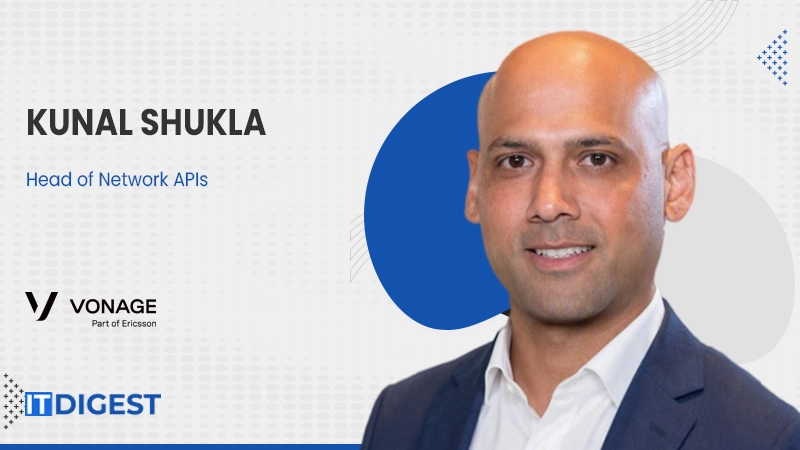
Kunal Shukla is SVP and General Manager, Head of Network APIs at Vonage, bringing more than two decades of experience across telecommunications, cloud computing, artificial intelligence, 5G, and enterprise technology. Throughout his career, he has held leadership positions at organizations including Google, Hewlett Packard Enterprise, Ericsson, Aricent, and Digital Barriers, driving technology innovation, product transformation, and business growth. At Vonage, he leads the Network APIs business, focusing on expanding Network-Powered Solutions that help enterprises and developers build secure, intelligent, and mobile-first digital experiences. His expertise spans network intelligence, programmable networks, AI-driven solutions, and enterprise connectivity.
Vonage is a global cloud communications company that helps businesses make their communications more flexible, intelligent, and personalized. It provides unified communications, contact center solutions, and programmable communications APIs through its cloud communications platform.
The company enables enterprises and developers to integrate voice, video, messaging, and network intelligence into their applications and business workflows. Its technologies help organizations improve customer engagement, streamline business communications, strengthen digital security, and develop connected customer experiences.