

Enterprise software has become better. Enterprise workflows have not always kept up.
Employees still move information between applications, check the same fields, download reports, update records and chase routine approvals. The systems may be different, but the problem is often the same. People are being used to connect processes that technology should have connected already.
This is what the power of enterprise robotic process automation is all about. Through RPA, software bots can automate mindless and rule-based tasks on multiple systems and software. The real value, however, is not in the efficiency gained through a more efficient handoff. Rather, the main advantage lies in lowering the amount of human intervention in those processes where humans do not add much value.
The gap is becoming harder to ignore. Accenture’s 2026 research found that only 21% of organizations are redesigning end-to-end processes with AI at the core, despite 86% planning to increase AI investment in 2026. The challenge is no longer simply getting access to technology. It is deciding how work itself should change.
What Does RPA Actually Do in the Enterprise
 Many people refer to RPA software as a tool that simulates human activities. Yes, it does but it makes enterprise automation look much simpler than it really is.
A bot may interact with the presentation layer of an application that the employee uses. It opens an ERP, retrieves the data from there, inputs the data into another application, checks a predefined rule and advances the workflow. This is helpful when enterprises have a number of systems which are not designed to work well with each other.
One of the reasons why RPA is still relevant despite the rise of API-based integration is the fact that enterprises do not always have the possibility to replace all legacy applications despite the existence of better systems. Many ERPs, CRMs, desktop apps, internal portals and spreadsheets may be used by an enterprise in its workflows.
Microsoft refers to the desktop flows in Power Automate as to RPA functionality which allows automating Windows desktop applications, services and experiences. The roadmap for 2026 covers desktop RPA with cloud workflows, process mining, orchestration and Copilot integration.
In other words, RPA may connect applications without having to re-engineer the whole IT landscape of the enterprise.
Core Business Benefits of Scaling RPA
The value of RPA becomes clearer when the discussion moves away from the bot and toward the work it removes.
Unmatched Operational Efficiency
There are processes that remain largely the same across transactions. They receive the same input, run the same checks and update the same fields. The major cost of getting humans to do all the steps of the process is the waste of their attention on the predictable tasks.
This type of process can be managed continuously by the RPA. With the growth of volumes, the organization does not have to adjust its operations through making the same number of manual steps.
66% of enterprises say that efficiency and productivity improvements are benefits of AI, according to Deloitte’s 2026 State of AI in the Enterprise survey. Cost reduction was a benefit, according to 40% of surveyed organizations.
Though these relate to the use of enterprise AI in general and not to RPA, it is obvious that the B2B logistics providers have seen such causes to automation. Companies are looking for something that removes the friction from their business, not something to add to their workflow.
Drastic Error Reduction and Regulatory Compliance
Repetitive work has another weakness. Attention drops when the task remains the same for hours.
That is when small mistakes creep in. A field gets missed. A value is entered incorrectly. A step is skipped. In a connected workflow, that small error can travel through several systems before anyone catches it.
A properly designed RPA workflow follows the same rules each time. That consistency can make it useful for finance, HR, customer records and other processes where repeatable execution matters.
But automation does not fix the process itself. If the rule is wrong, the bot will apply the wrong rule very efficiently. That is why process review has to come before automation.
Also Read: Data Science in Enterprise Business: How Organizations Turn Data into Smarter Decisions and Growth
Empowering the Human Workforce
The better question is not how many people RPA can replace. It’s the amount of low value work it can replace in jobs that still have work to do.
Likewise, an employee who is entering data about customers from their desk for an hour does very little judgment with his hour. Neither does a worker who is constantly auditing certain invoice fields against preset rules.
With those steps automated, people can then spend their time on exceptions, analysis, conversations and decisions with their customers.
That is a more useful measure of automation. The point is not simply to reduce human involvement. It is to reserve human involvement for the parts of the process where it actually matters.
Top Enterprise RPA Use Cases by Department
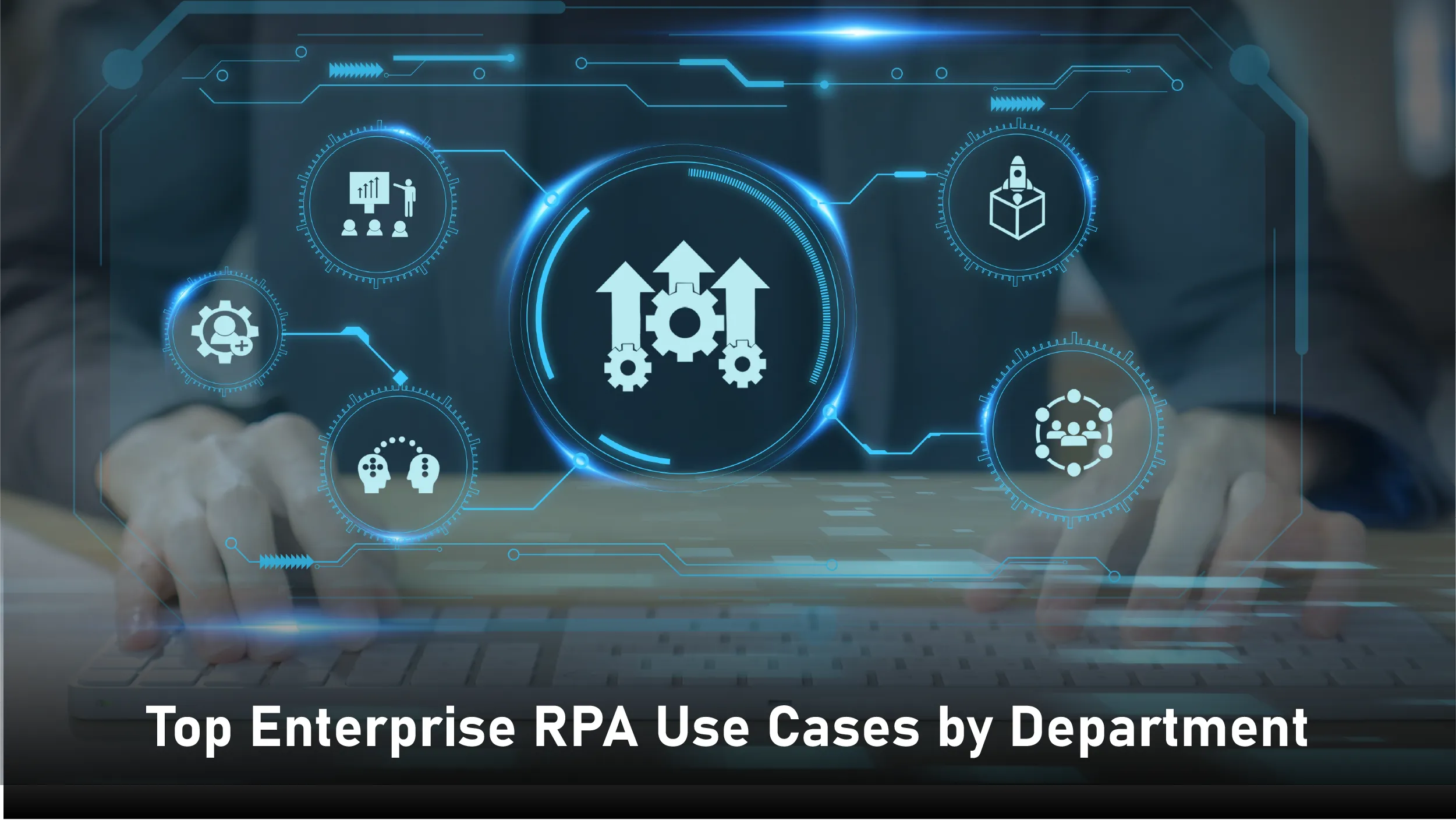 The typical processes that would benefit from RPA have a few things in common. They are repetitive, rules-driven, voluminous and cross-systems.
Finance and Accounting is the immediate leader. RPA can play a role in the invoice processing, routing AP (Accounts Payable) and reconciling at the end of the month. Instead of copying and pasting the information from one financial system to the next, workers will need to look at the outliers and decision scenarios.
There is a lot that Human Resources can do too. Employee onboarding process involves the entry of the same data into multiple systems. Payroll processing and benefits enrollment have structured processes which can be automated once the rules are known. This way HR department will spend less time maintaining records and more time working with people.
Customer service is yet another area where RPA can help. A simple request requires an agent to update several customer records before closing the ticket.
The department is not really the deciding factor. The workflow is. If people are repeatedly doing the same steps and the outcome can be defined in advance, the process deserves an automation assessment.
Step by Step On How to Implement RPA in Your Organization
The first question should not be which RPA platform to buy. It should be which process is worth automating.
Start with process discovery and mining. Look for work that happens frequently, consumes employee time and follows predictable rules. Pay particular attention to system-to-system transfers, repetitive checks and workflows with too many manual handoffs.
Then evaluate vendors against those actual requirements. Of course security is a concern; but so is UI automation, API capabilities, orchestration, oversight, error handling, and scalability. So as eye-popping as the truly awesome thing you display in the demo is; you’ll get the totally opposite result when it’s faced with an old app, or a new screen, or a not-so-pristine real-world scenario.
It’s now time for proof of concept. Select just one process that has a clearly defined problem and that delivers a specific outcome to test. Begin by establishing a baseline. How long does the process take? How many manual steps does it involve? Where does it get bogged down? What usually goes wrong?
The PoC should answer whether the process became better, not merely whether the bot worked.
Once automation starts spreading, establish a Center of Excellence. Governance becomes important when different teams begin creating different bots, standards and access models. A CoE can bring structure to development, security, monitoring, ownership and maintenance.
That is the point where RPA stops being a collection of departmental experiments and starts becoming an enterprise capability.
Common RPA Pitfalls and How to Avoid Them
RPA has a practical weakness that is easy to overlook. Bots depend on the environments they operate in.
A change to an application’s interface can break an automation that relies too heavily on a particular screen layout. That means maintenance, monitoring and exception handling cannot be treated as afterthoughts.
Then there is the bigger issue of process quality. You can automate a poor process as easily as a good one. If the process isn’t lean, a bot is just going to escalate the issues to a higher level of inefficiency.
Resentment among the workforce can be yet another concern. Employees want to know what is changing with automation, as well as what is happening to the time it might save them. If the only message provided is that they are automating a task, many employees will object to the project.
Good RPA starts with better process decisions.
The Future from RPA to Intelligent Agentic Automation
Traditional RPA works well when the rules are clear and the expected outcome is known. Enterprise work is not always that predictable.
Generative AI and AI agents are beginning to change that boundary. IBM’s March 2026 RPA release added the ability for MCP-compatible AI clients such as Microsoft Copilot, IBM Bob and watsonx Orchestrate to discover and execute IBM RPA bots.
That points toward a different model. An AI agent can determine what needs to happen, while RPA handles the precise actions inside an existing system.
RPA therefore does not necessarily disappear as agentic automation grows. It can become the execution layer for tasks that still need predictable, step-by-step control.
Conclusion
The mistake would be to treat RPA as a shortcut around process problems.
According to the World Economic Forum, Intelligent Industrial Operations Outlook 2026, there’s a transition from conventional automation to more intelligent connected and autonomous systems, with humans working alongside intelligent systems, together, in real-time. That transition more so than not increases the importance of process design.
Enterprises do not have to automate all the mundane tasks they encounter. They should focus on those activities that relentlessly drain human attention but don’t call for a lot of human judgement.
Start there. Fix the workflow, measure what it costs today and run one focused proof of concept. If the results hold, scale it with governance.
That is when robotic process automation in enterprise stops being about bots and starts becoming a better way to run the business.
