

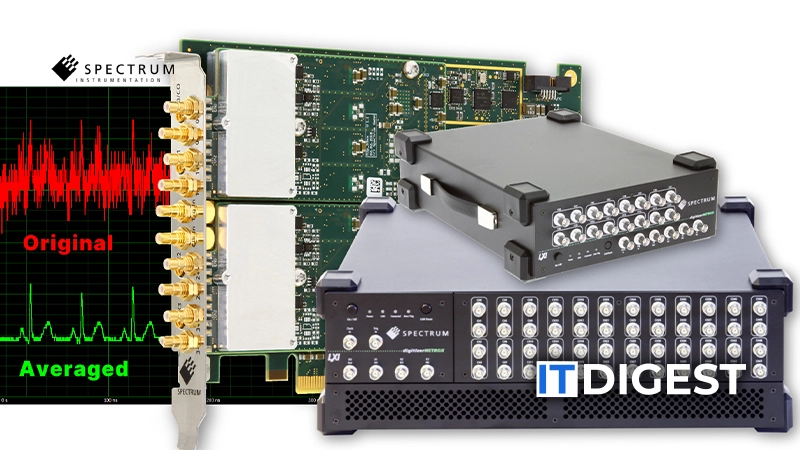
General-purpose digitizers get onboard averaging function
Spectrum Instrumentation has introduced a new firmware option that enables its high-resolution 59xx series digitizers to perform onboard summation averaging. Averaging is a useful tool for reducing unwanted signal noise while, at the same time, improving measurement resolution, dynamic range, and signal-to-noise ratio (SNR). By performing the averaging directly in the onboard FPGA, the option significantly reduces the amount of data that must be stored or transferred for analysis. The result is a processing tool that allows the averaging of high-repetition-rate signals at up to 2 million events per second.
“This new option for the 59xx series provides an exceptional waveform averaging capability for users who need to characterize signals that may be masked or distorted by unwanted noise,” said Spectrum’s Director of Technology, Oliver Rovini. “The FPGA-based processing allows ultrafast averaging, even on waveforms that contain as many as 64 KiSamples per acquisition. It’s ideal for users working with signals or pulses that are low level, or where signal details are being lost due to high amounts of noise. This includes applications such as mass spectrometry, lidar, radio astronomy, automation, radar, biomedicine, nuclear physics, communications, sonar, and many more.”
Also Read: Rohde & Schwarz presents unique R&S NTS transfer standards for RF power traceability applications up to 170 GHz
About the 59xx Series Digitizers
The 59xx series digitizer range includes 24 PCIe card variants and 28 Ethernet-based instruments. The products offer maximum real-time sampling rates from 5 MS/s up to 125 MS/s, with 16-bit resolution and a choice of input channels ranging from 1 to 8 per PCIe card or from 4 to 48 per stand-alone instrument.
Connecting the PCIe cards together with the company’s proprietary Star-Hub system also enables the creation of acquisition systems with up to 128 fully synchronized channels. The PCIe cards allow streaming of acquired data to PCs or GPUs over the bus at rates of up to 700 MB/s.
About Summation Averaging
Summation averaging is a time-domain-based processing technique that reduces the random (uncorrelated) noise component of a signal and improves its signal-to-noise ratio (SNR). At the same time, the process increases a digitizer’s measurement resolution and dynamic range. Figure 2 illustrates how summation averaging can reveal signal details that would otherwise remain hidden by excessive noise.
In the example, a low-level signal (approximately 300 µV) is acquired by an M2p.5962 digitizer sampling at 125 MS/s. The signal is completely buried by random noise (top trace). Averaging eight times (middle trace) reveals details invisible in the original single-shot acquisition, with three pulses that occur every 3.6 µs.
Averaging 64 times (lower trace) improves the signal quality even further, exposing a pulse with an amplitude of approximately 300 µV, together with smaller pulses after it.
Ideally, if the noise is random while the signal is repetitive, then the summation averaging function can improve the SNR in proportion to the square root of the number of measurements (or averages). For example, averaging a signal 64 times may improve the SNR by as much as 12 dB or increase measurement resolution by around 2 bits. As such, summation averaging is a valuable tool that can be used to improve and extend the 16-bit resolution of the 59xx series digitizers. The new option, named M2p.xxxx-spavg, is available immediately for new 59xx series digitizers and can also be installed as a field upgrade on existing units.